01
RECOVER YOUR DIRECTION
Get a struggling project back on track.
Every week of slippage has a price. Isolate the cause that really consumes the float, cost your options at P50 and P80, and decide before the next committee.
Explore project recoveryOn a major project, every trade-off settled in committee ends up on someone’s table one day: the client’s, the expert’s or the arbitral tribunal’s. SherpaPM costs its impact on time and money before you decide, then keeps dated evidence of what you knew when you decided. On top of your tools, with experts at your side.
See a real decision record Training case, fictitious data, read-only. Added to your workspace the first time you open it.
Primavera, SAP, document systems and models stay in place: SherpaPM connects to them.
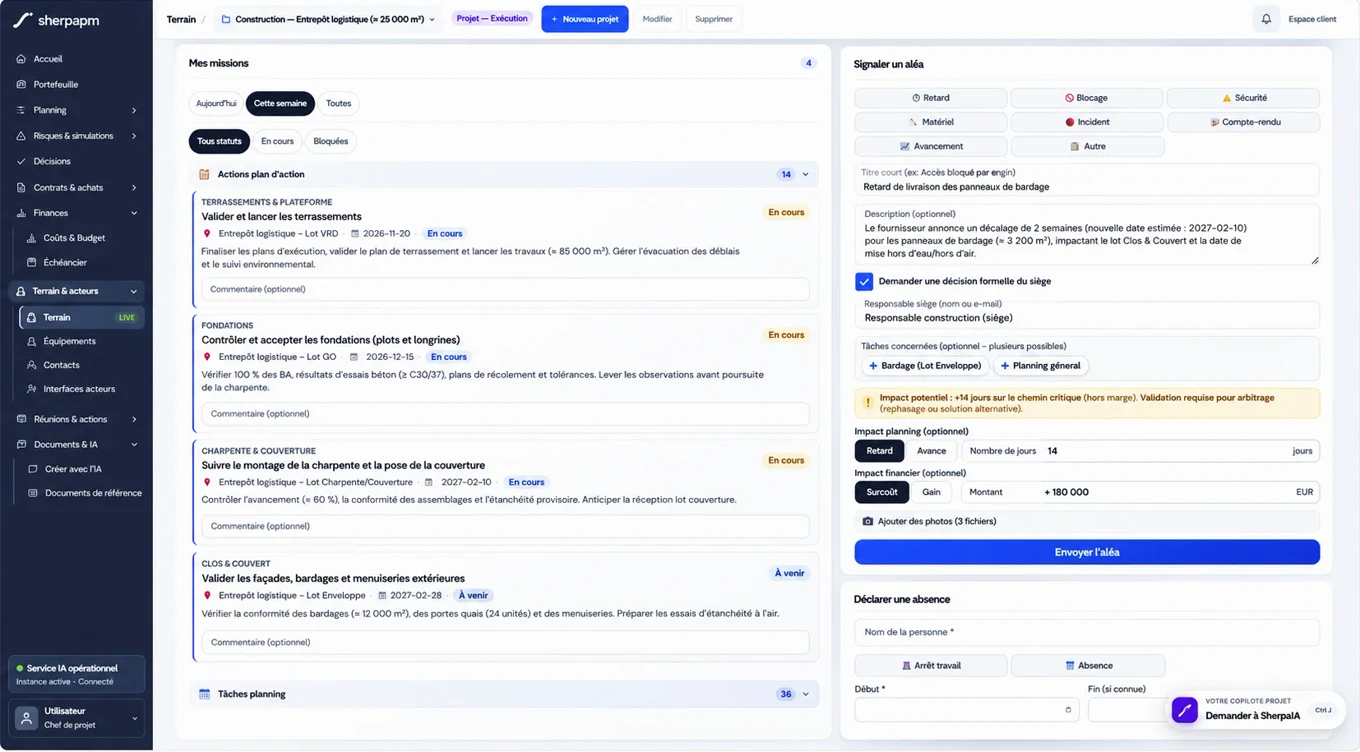
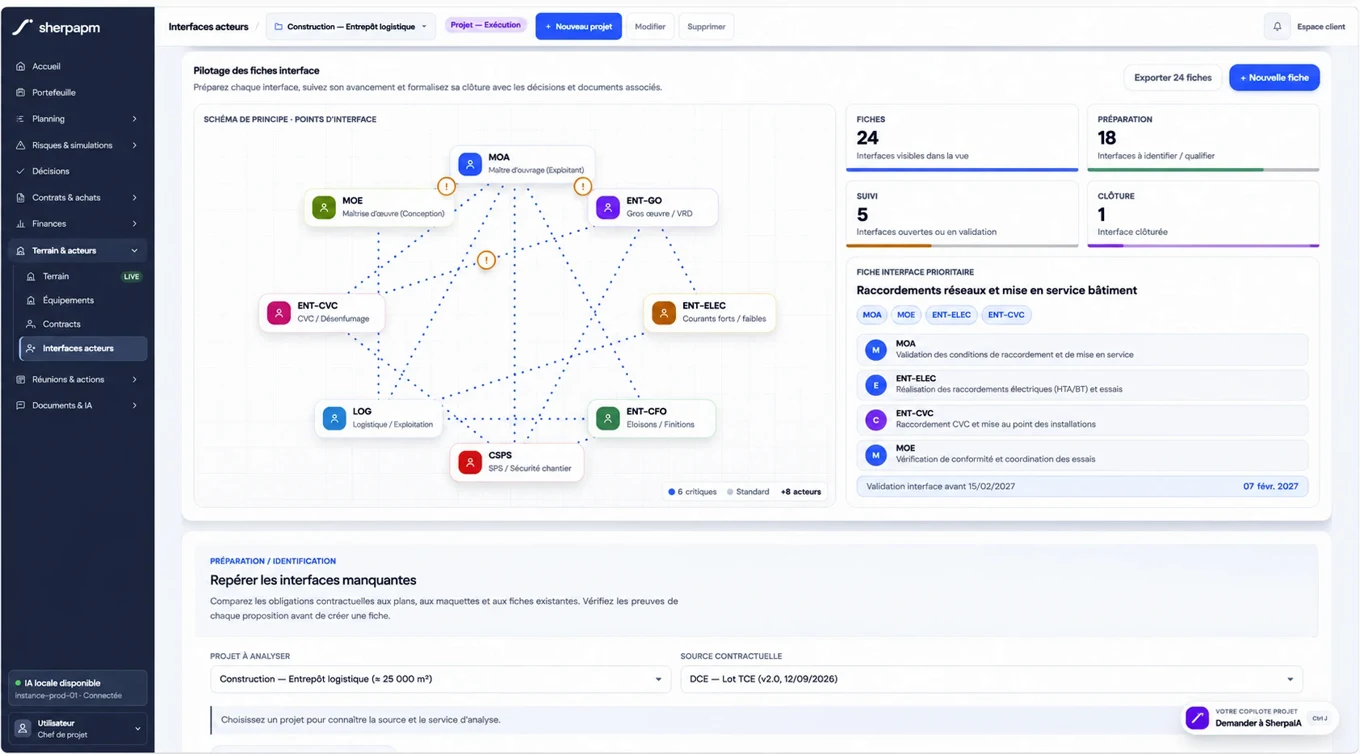
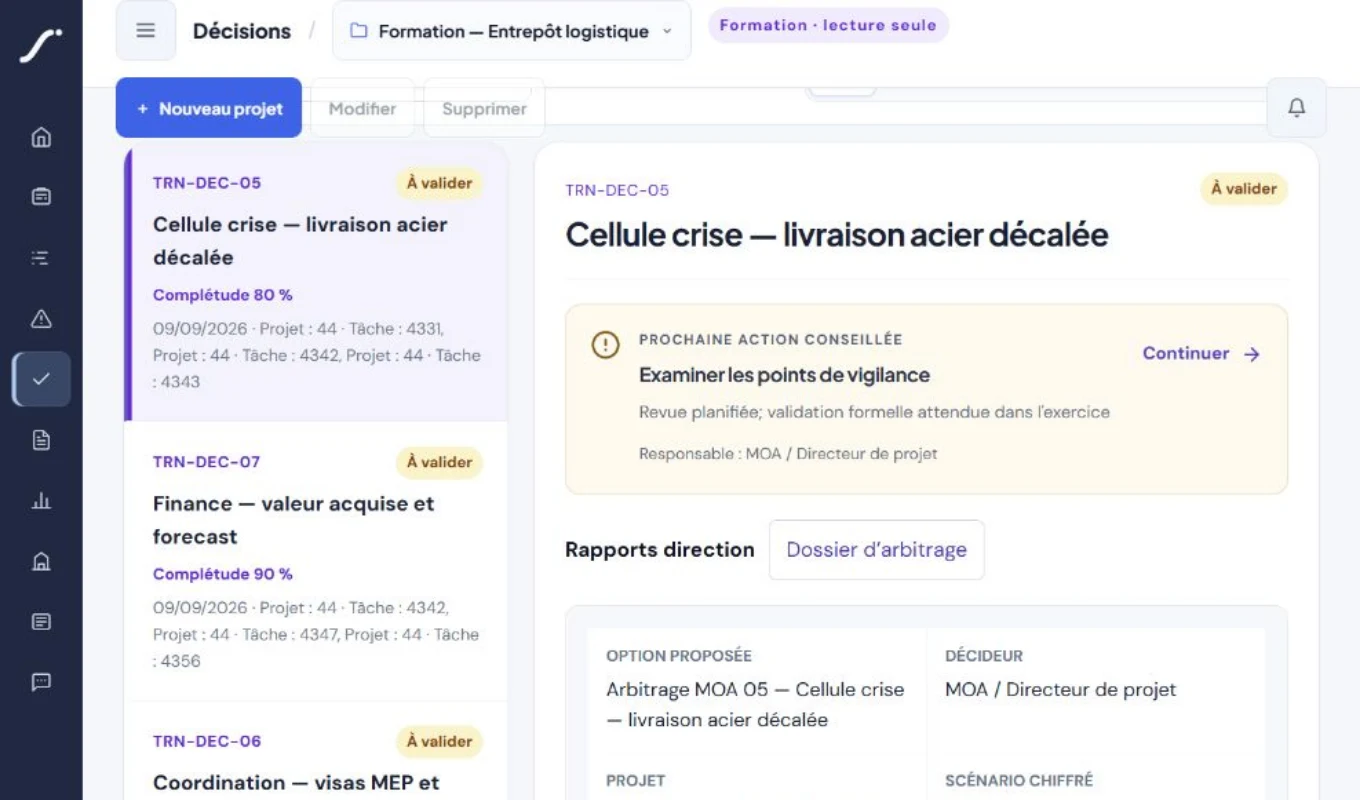
A laptop opens to SherpaPM. IFC 3D models, 2D drawings, the Primavera schedule, SAP costs, contracts, email and meeting notes converge into the software, each record with its source. The screen shows schedule health, the cash position, then schedule quality scored 91.9 out of 100. A fictitious logistics warehouse under construction assembles discipline by discipline: structure, ventilation, power and the HV/LV room, sprinklers, among the site’s lifts. SherpaPM finds five clashes between the fire main and the roof rafters, then the view switches to the 2D drawing, where revision B is overlaid on revision A and the interface decisions go back to review. Finally, the decisions screen ranks the delays that drive the finish date by financial exposure, shows who pays and what acting would gain; options are costed, the decision is checked before it is recorded, and the project history is ready for a claim or arbitration.
What SherpaPM can read
Two moments when a decision gets expensive
Deciding without costing means paying later. Justifying without dated records means negotiating from weakness. We start from a real decision on your project, never from a tool roll-out.
RECOVER YOUR DIRECTION
Every week of slippage has a price. Isolate the cause that really consumes the float, cost your options at P50 and P80, and decide before the next committee.
Explore project recoverySECURE THE TRADE-OFFS
Every trade-off is prepared, costed and recorded with its reasons. When a change calls it into question, it goes back to review before it takes effect, not after.
Explore end-to-end supportRECONSTRUCT THE FACTS
A claim received or to bring, a defence, arbitration proceedings: recover the dated thread of facts and records, for and against, before the other party writes it for you.
Explore reconstructionWhy SherpaPM
Primavera, SAP, document systems, models: your tools record what was done. The reason behind each decision gets lost between two committees. SherpaPM connects to them and keeps what happens between them: clashes, decisions, records and financial consequences.
Each fact carries two dates: when it happened, then when it became known. Records are chained by fingerprint, any alteration shows, and the decision history can be replayed on any date.
IFC models, PDF and DXF drawings, Primavera, SAP, document systems: SherpaPM reads what exists, computes clashes between disciplines and flags the decisions a new revision calls into question.
Simulated impact on time and cost, earned value, compared options. An incomplete decision (missing source, single option, open contradiction) is not recorded.
Notice periods tracked, sourced chronology, allegations tested against the records, for and against: a structured file for your counsel and experts. The legal position remains theirs.
Competitive edge
Mission 01Diagnosis · Scenarios · Recovery
Add people, postpone a delivery or revise the scope? SherpaPM first isolates the cause that really moves the milestone: the one consuming critical-path float. Then we cost each option with you, including its uncertainty (P50, P80), before you commit to a new course.
Discuss your recovery planAnimated film. A commissioning milestone slips by 42 days. Of three delays, only the one exceeding the float on the critical path moves the milestone. Three options are costed and compared: resequence the work, add targeted resources or postpone. Project management selects targeted resources; the decision is recorded, then turned into dated actions with owners. In this example the trajectory is recovered at 5 days instead of 42.
ESTABLISH THE FACTS
We compare the baseline schedule with progress reported by the teams. Critical-path analysis separates delays absorbed by float from the one that moves the milestone. Causes still to be checked are listed.
COMPARE THE OPTIONS
We compare resequencing, adding people where needed and shifting a date. For each option, a Monte Carlo simulation gives the likely time and cost, alongside the risks and assumptions to check.
ORGANISE THE RECOVERY
You choose a scenario. Together with the people responsible, we assign actions and dates and agree when to check progress so the next deviation can be addressed.
What you getA recovery plan with clear priorities, owners and dates.
Mission 02Scoping · Trade-offs · Handover
From the outset, we help your team identify which decisions are due and at which reviews. SherpaPM keeps the memory of each decision. When a substitution or a new model revision challenges it months later, it goes back to review before it takes effect.
Secure your trade-offsAnimated film. A major project is shown as a climb from camp to camp up to handover. At launch, each decision role is set. At each review a decision is linked to an owner and a due date. A field report leads to rescheduling an intervention and the proof returns to the file. A technical substitution proposed during execution challenges a decision taken fourteen months earlier, so it goes back to review. At handover, the operator receives the decisions, open reservations and commitments to transfer.
AT LAUNCH
We agree milestones, responsibilities and a review schedule. Your team identifies decisions ahead of time so they can be addressed before they hold up the work.
DURING DELIVERY
Before each committee, change requests, risks and deviations arrive with their costed impact on time and money. Each decision is linked to its rationale, its records, an owner and a due date.
AT DELIVERY
We check open commitments with their owners. The incoming team receives the decision history, supporting records and outstanding issues to resolve.
What you getThe memory of decisions, with their rationale and records, handed to the team taking over.
Mission 03Claims · Disputes · Arbitration proceedings
What was planned. What happened. What was decided. SherpaPM reconstructs the project’s history from available records. Each fact keeps the date it happened and the date it became known, and any alteration of a record shows. Deviations and contradictions come into focus, for and against. The legal position remains your counsel’s.
Let’s prepare your caseAnimated film. A claim arrives: 25 days of extension and 0.9 million euros of extra costs. Thousands of records are scattered. The schedule set acceptance on 18 June, the site on 21 June, and the contract requires the test report: the contradiction is shown, not decided. Records are placed back in time with the date each event occurred and the date it became known. Each allegation is set against the records that support it and those that contradict it. Each record carries a fingerprint that reveals any alteration. Three files take shape: claim, defence and arbitration proceedings; the legal position remains the counsel’s.
THE STARTING POINT
The contract, baseline schedule and original commitments establish a common starting point for understanding the project.
THE SEQUENCE OF EVENTS
Correspondence, meeting notes, changes and observations are brought together to reconstruct the sequence of facts.
QUESTIONS TO CLARIFY
Decisions, deviations and consequences are linked to available records to prepare a negotiation, a claim, a defence or arbitration proceedings.
What you getA sourced chronology. Facts linked to their records, ready for your counsel’s review.
Fictitious case · logistics warehouse
The HV/LV package is awarded late. The general-works contractor has already closed its design to start on site. Coordination freezes the electrical room without regulatory and maintenance requirements. Here is how SherpaPM works the case, step by step.
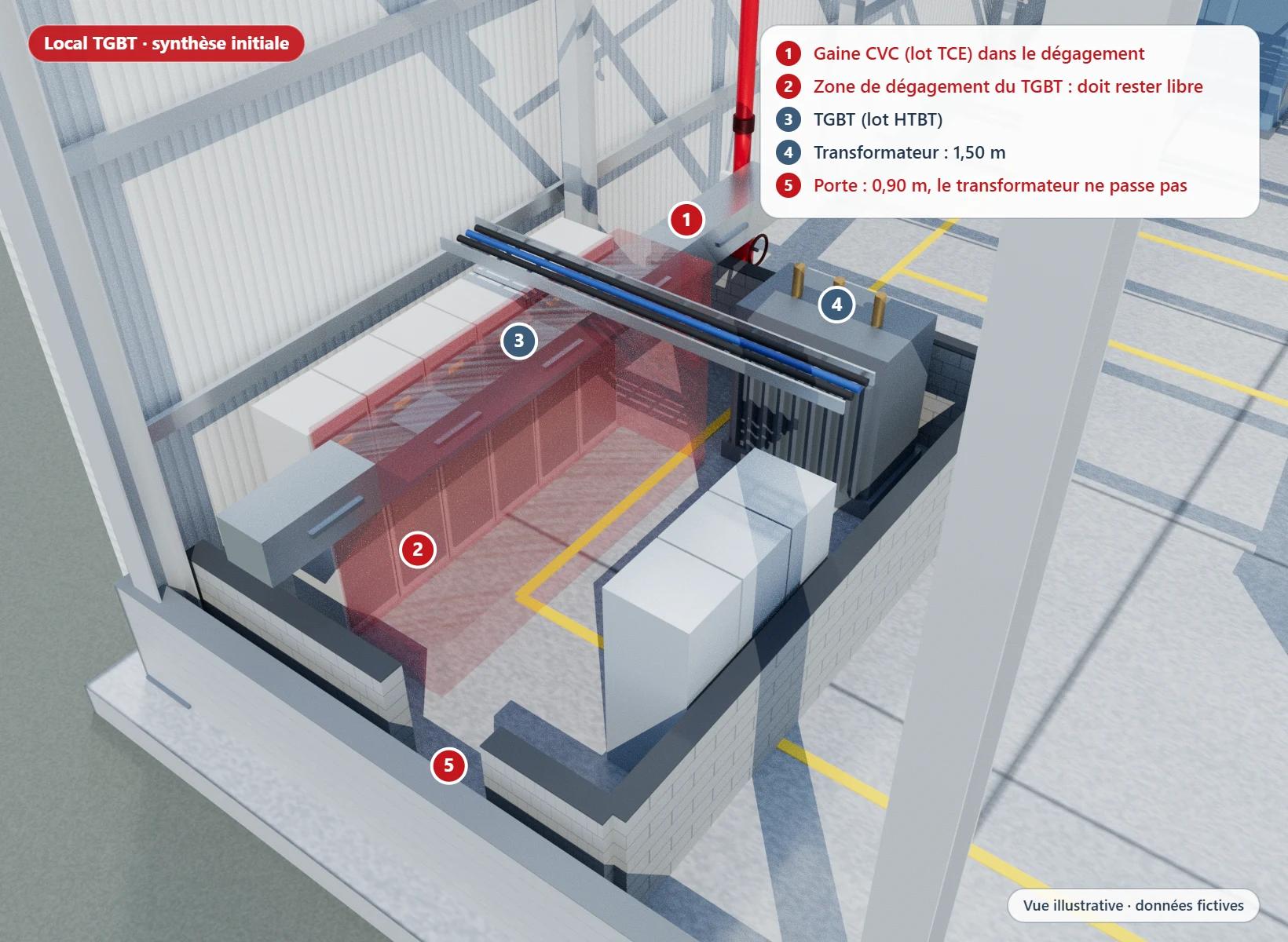
01 · The problem
Design had to close fast so the general-works contractor could start. The HV/LV package, awarded late, was left out of coordination. General works in the room are due to start on 3 June.
Fictitious data generated by SherpaPM. This case is not a client pilot, a real model, a certification or a regulatory compliance opinion.
Demanding projects, shared responsibilities
For leaders who make the calls on complex projects, from investment to operations. One thread of decisions and evidence, shaped around each sector and each role.
Choose a badge to explore the sector’s challenges.
Scroll through the badges · Hover over or pull a badge · AI-generated illustrationsSelected sector01 / 05
Energy · Solar
Photovoltaic projects: connect design, procurement and grid connection to prepare commissioning.
Points to consider
Link orders, deliveries and installation sequences.
Track electrical interfaces and connection prerequisites.
Bring together inspections, outstanding items and performance commitments.
OWNERS
Maintain control of the programme, budget and key decisions.
DESIGN
Coordinate studies, interfaces and technical deliverables.
CONTRACTORS
Connect execution constraints, resources and contractual commitments.
AMO / PMO
Prepare trade-offs, quantify deviations and trace decisions.
OPERATORS
Prepare acceptance, commissioning and continuity of operations.
From the field to decisions
A fact reported by the team informs a choice. Once approved, the decision becomes an action to carry out and verify in the field.
Disruptions, blockers and observations come back dated, with photos and records. The fact is assessed on evidence, not on hearsay.
Information governance
You should be able to justify a disputed milestone without sharing the whole file. SherpaPM links project information to its source. With your IT team, you define who can use it and in which countries it may be processed.
 Fictional example
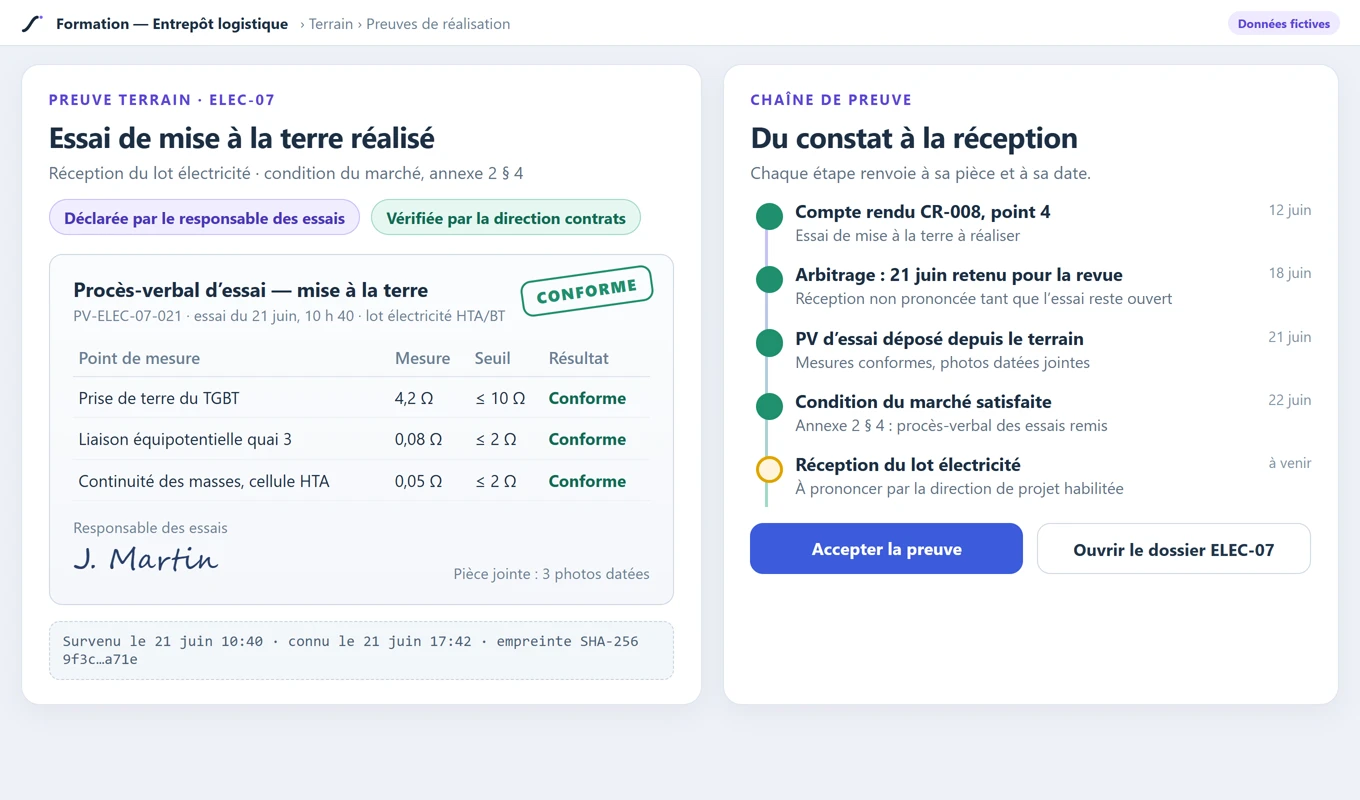
Decision file ELEC-07
Same package, same milestone: the schedule says 18 June and the site says 21 June. Which date can the committee use?
Project catalogue
PLN-017Revision 03Forecast date
The site forecast is 3 days later than the schedule.
Follow the arbitrationResolving conflicting evidence
Both records refer to acceptance of package ELEC-07. They disagree on the forecast date; the contract sets out what is required to confirm acceptance.
SherpaPM presents the values and source excerpts for the same structured fact. The analyst checks they refer to the same milestone and sends both dates to the people responsible for verifying them.
Document search
Start with a reference or a few words to find the relevant passage, its date and its source record.
In a local test, 20 searches for distinct references each returned the expected passage. Volume and response times must be assessed on your own systems.
1 passage
Data sovereignty
With your IT and security leads, we assess deployment inside your systems or in a hybrid environment. We review hosting locations, the laws governing service providers and their remote access. You approve the scope before go-live.
Scoping brief
Before committing: agree access logs, restore testing, incident handling and the terms for returning or deleting records.
Three ways to start
Each format starts from a real case. Scope, deliverables and the date of the first result are set before you commit.
Spot what will be expensive before it costs you: technical, organisational and contractual interfaces, listed and sourced.
You get
First deliverable: the interface register
Scope a diagnosticOne dispute, one package, one period: the factual material for a claim, a defence or arbitration.
You get
Working on a dispute for a client? Per-project access rights; the analysis and the position remain yours.
First deliverable: the sourced chronology
Scope a pilot filePlatform and expertise, committee after committee, through to handover.
You get
From the first committee: the decision log
Plan ongoing supportEach format is quoted individually. The first conversation can take place without confidential documents.
Before you commit
Yes, starting from a narrow scope — one dispute, one package, one period — and the records available. The first deliverable is a sourced chronology that surfaces contradictions and missing records, prepared for review by your counsel and experts.
No. SherpaPM organises facts, records and analyses, and flags what is established, disputed or missing. Liability, final quantum and strategy remain with your counsel, experts and lawyers.
Those tools remain the reference in their field, and SherpaPM connects to them. It keeps what happens between them: which model clash affects which interface, which decision depends on it, which records it rests on and what was known when it was taken. An incomplete decision is not recorded, and its history stays verifiable.
IFC models (IFC2x3 and IFC4) and PDF and DXF drawings. Revit, CATIA or 3DEXPERIENCE, DWG or DGN files are kept on file; analysing them requires an IFC, PDF or DXF export from your design software. Schedules are imported from Primavera P6 (XER) or connected through Primavera Cloud.
The proposal defines consulting, deliverables and the role of software, along with configuration or data connection needs. The quote specifies costs, exclusions and change conditions for the agreed scope before signing.
Scoping starts with your existing tools and files. We check formats, data quality and import or connection options. Any preparation or specific connections are identified in the proposal; scenarios are developed within SherpaPM.
Before sharing sensitive records, your representatives approve confidentiality, hosting, access, any AI processing, retention and data return conditions. These points are documented in the relevant agreements. The first conversation can take place without confidential documents.
The next step
Describe the trade-off to settle, the claim you received or the dispute to defend. We shape the mission that answers it with you.
contact@sherpapm.fr